Reviews
Part of Does a real stationery maker look any different from a rebadged import?
What belongs in a first-run stationery tool kit?
The tools a first small run actually needs, what to borrow instead of buying, and the safety habits that matter once you start cutting in quantity.
Making twenty of something is a different problem from making one. Repetition punishes every tool that is slightly wrong and every process that depends on care rather than on a jig. This is the list for a first run, in the order it becomes necessary, plus the things worth borrowing before you buy.
What to take away
- Buy for repeatability. A jig or a template beats a better blade.
- Borrow the expensive machines before buying them. Access is widely available.
- Cutting in quantity is where injuries happen, so set the rules before the first run.
- A scale and a consistent package are worth more than any decorative upgrade.
The kit for a first run
| Tool | Why it earns its place | Borrow or buy |
|---|---|---|
| Steel rule and self-healing mat | Straight, repeatable cuts | Buy |
| Craft knife, plenty of blades | A dull blade is the dangerous one | Buy |
| Bone folder | Clean folds without cracking | Buy |
| Templates or a simple jig | Every piece identical | Make |
| Awl and bookbinding needles | Sewn bindings | Buy |
| Guillotine or trimmer | Speed at quantity | Borrow first |
| Scanner and design software | Artwork and reprints | Borrow first |
| Kitchen scale to one gram | Postage and pricing | Buy |
Borrow the digital side before buying it
Beginners overspend on design and reproduction. This is also the part most widely available to borrow.
A university book arts program shows the shape of a working setup. The University of Iowa Center for the Book's digital lab sits next to its binding, papermaking and printing rooms. It holds computers with current design software, plus printers, scanners, cutting tools and a camera.
Libraries, maker spaces and community colleges increasingly offer the same combination by the hour. Use one for a first run and you will learn which of those machines you actually need. A maker space can also show you how real indie stationery brands run a first production batch.
Safety, once you are cutting in quantity
Cutting one card is nothing, but cutting two hundred is repetitive work with a sharp blade and a tired hand. That is a different activity, and institutions treat it as its own category.
Stanford's guidance on shop and makerspace safety covers academic shops on campus, spanning wood, metal, electrical, sculpture and model-building work, because shared workshop activity needs stated rules.
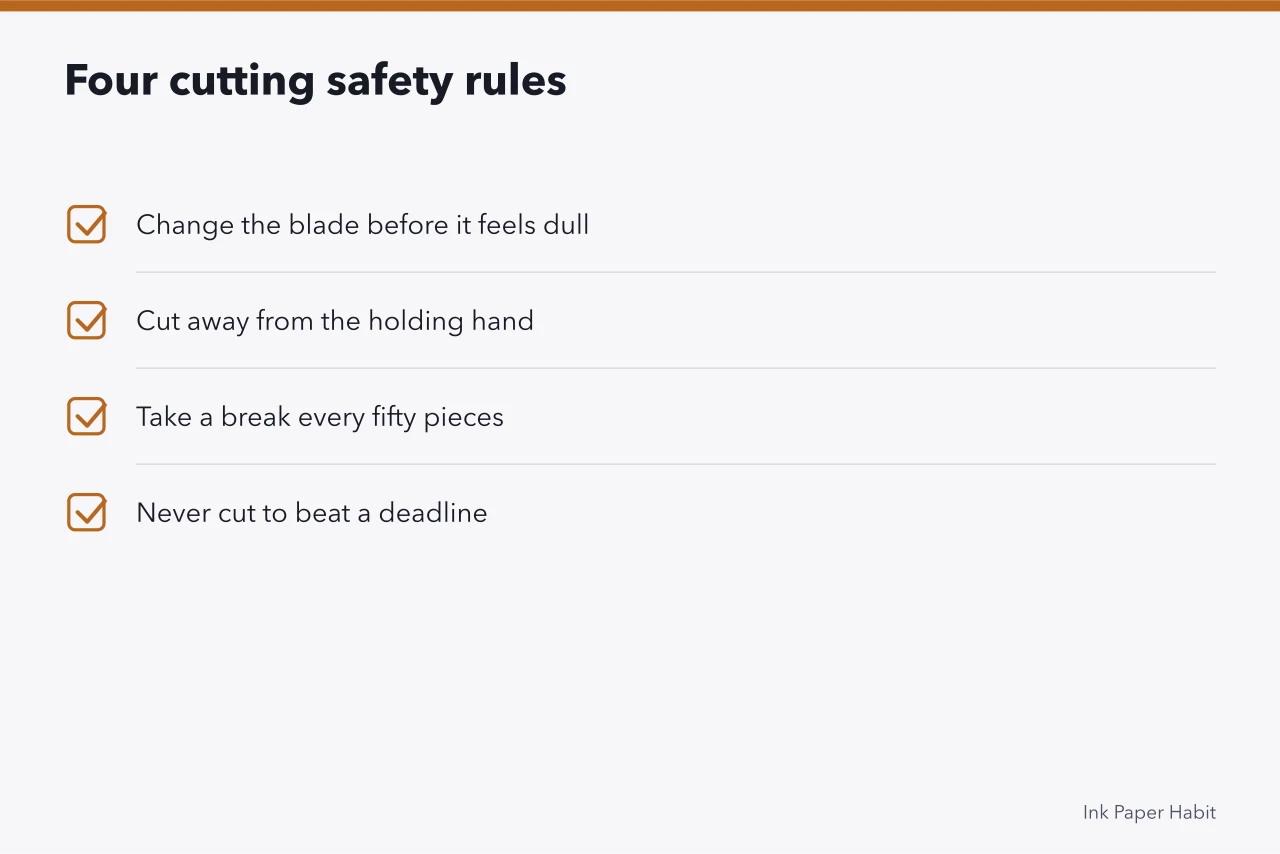
Your version is four rules. Change the blade before it feels dull. Cut away from the hand holding the work. Take a break every fifty pieces. Never cut when you are trying to finish before something else starts.
Jigs are cheaper than skill
The difference between twenty pieces that match and twenty that nearly match is almost never the maker's hand. It is whether there was a jig. A piece of scrap board with two stops glued to it will square every card the same way, faster than measuring, and it costs nothing. Make the jig before the run, not halfway through it.
What not to buy for a first run
- Branded packaging, before you know the finished dimensions.
- A large paper cutter, before you have cut a run by hand and felt the bottleneck.
- Foil, embossing or specialty finishing equipment, which is a second-run problem.
- Bulk stock of any material you have not made a prototype from.
Make one, then twenty, then decide. The formats that make a first run finishable are in ideas worth trying, and the paperwork that goes with selling is in what a maker has to get right.
Common questions
Do I need a guillotine? Not for a first run. A steel rule and a sharp knife give a cleaner edge than a cheap guillotine, which crushes the fibers at the cut.
How do I get twenty pieces identical? A template and a stop. Mark once, cut against the same edge every time, and never measure each piece individually.
Is a home printer good enough? For proofs, yes. For a sale run, get one professional proof printed before committing, because color and paper handling both change.
What is the most common tool mistake? Working with a dull blade. It produces a ragged edge, and it is also the main cause of the slips that cut fingers.