Features
Importing Fountain Pen Ink Into the US: Customs, Duty and Fees Explained
A US guide to importing fountain pen ink: de minimis limits, HTS codes, duty rates, carrier brokerage fees, and how to estimate the real landed cost.
What to take away
- Importing fountain pen ink into the US starts with the $800 de minimis threshold, with exceptions.
- Fountain pen ink usually falls under HTS heading 3215, while pens sit in heading 9608; the exact code sets the duty.
- Carriers may add brokerage, advancement, or disbursement fees even when the duty rate is zero.
- State use tax can apply after customs clearance and is separate from federal duty.
- Canadian imports follow CBSA rules, not US de minimis, so check both sides before shipping.
The $800 De Minimis Threshold
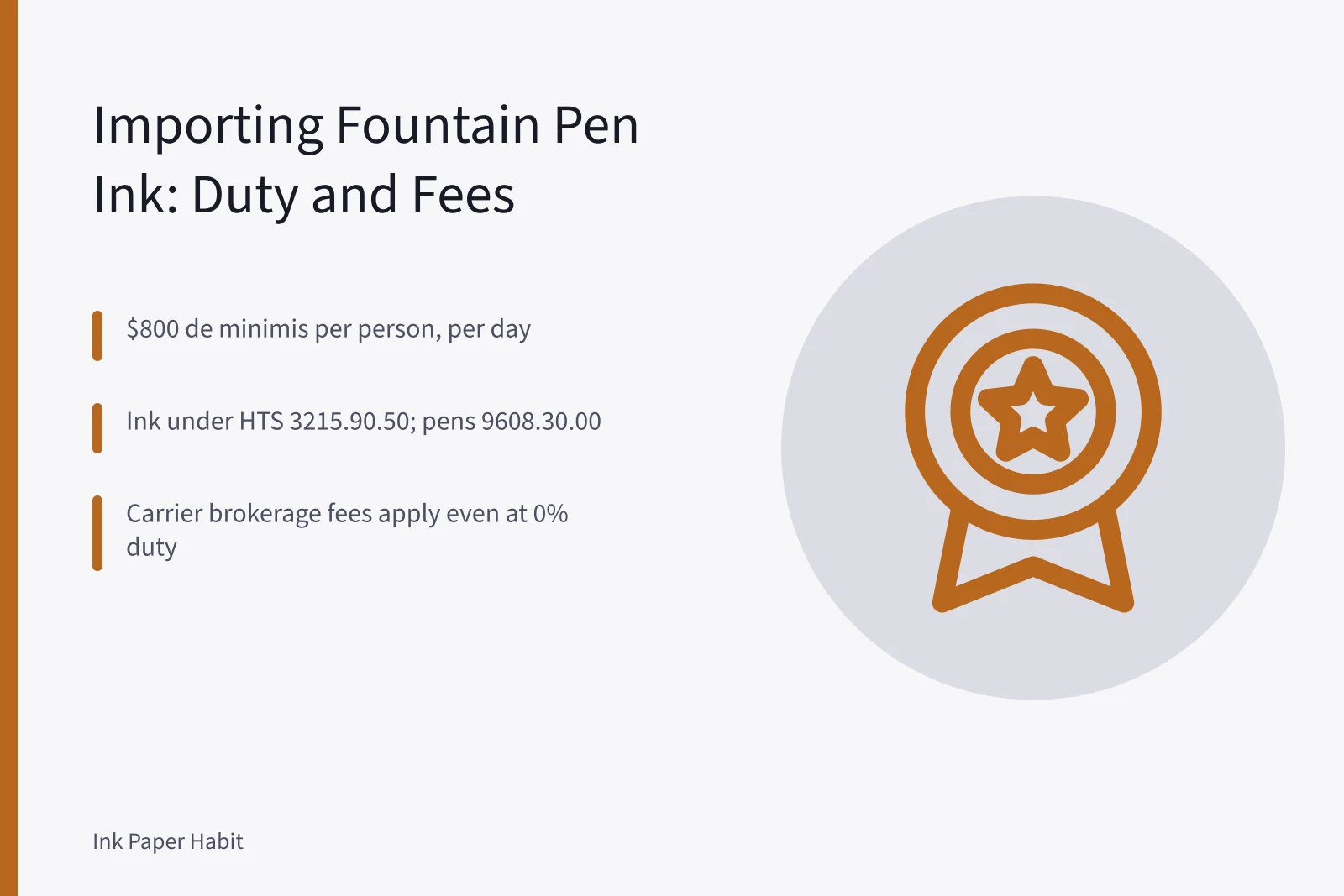
US Customs and Border Protection (CBP) applies Section 321, often called de minimis. A shipment valued at $800 or less can enter free of duty and tax. The limit is per person, per day, not per parcel.
If one person receives multiple parcels on the same day, CBP can combine their values. Goods subject to certain partner government agency rules, anti-dumping duties, or quotas may not qualify.
For ink and pens, most personal orders under $800 clear without duty. For the Canadian side of the same purchase, our guide explains CBSA duty and GST before you ship.
HTS Classification for Ink and Pens
CBP uses the Harmonized Tariff Schedule (HTS) to classify imports. Fountain pen ink generally falls under heading 3215. The common statistical line is 3215.90.50 for other inks. Fountain pens and stylograph pens sit in heading 9608, often 9608.30.00.
HTS Codes for Stationery Items
Item
- Fountain pen ink
- 3215.90.50
- Fountain pens
- 9608.30.00
- Notebooks
- 4820.10.20
- Mixed stationery
- Multiple
HTS heading
- Fountain pen ink
- Often free
- Fountain pens
- Depends on origin
- Notebooks
- Varies by binding
- Mixed stationery
- Classify separately
Duty note
- Fountain pen ink
- Fountain pens
- Notebooks
- Mixed stationery
Notebooks and paper may fall under heading 4820. A mixed stationery parcel can contain several classifications. Stationery covers paper, pens, and ink accessories, so a single order may need separate lines.
HTS Classification
| Item | HTS heading | Duty note |
|---|---|---|
| Fountain pen ink | 3215.90.50 | Often free under Column 1 General |
| Fountain pens | 9608.30.00 | Rate depends on origin and current schedule |
| Notebooks | 4820.10.20 | Duty varies by binding and paper |
| Mixed stationery | Multiple | Classify each item separately |
Country of origin matters as much as the code. A pen made in Japan may enter under different terms than the same pen made in Germany. Free trade agreements can reduce or remove duty, but the seller must provide proof. Always check the current HTS and CBP rulings before you rely on a code.
Carrier Brokerage and Disbursement Fees
Private carriers such as UPS, FedEx, and DHL publish brokerage fee schedules. They may charge a percentage of the duty with a minimum fee. They may also charge an advancement fee for paying duty on your behalf. USPS can charge a customs clearance fee for formal entries. These fees apply even when the duty rate is zero.
Carrier Fee and Customs Checklist
- Confirm HTS code for every item
- Check country of origin and trade agreement
- Use price paid as customs value
- Add carrier brokerage, advancement, disbursement fees
- Add state use tax if required
Ask the seller which carrier they use. Request the brokerage and disbursement fee schedule before you buy. A low item price can become expensive after carrier fees. For small ink orders, postal service often costs less than express courier.
- Confirm the HTS code for every item in the parcel.
- Check the country of origin and any trade agreement.
- Use the price paid for the goods as the customs value.
- Add carrier brokerage, advancement, or disbursement fees.
- Add state use tax if your state requires it.
- Commercial invoice with item descriptions and values
- Country of origin statement for each product
- HTS code listed on the invoice
- Tracking number and carrier fee schedule
The $800 de minimis limit is per person, per day. Splitting one order across two parcels on the same day does not double the limit.
Example: A $120 Ink Order from Japan
Suppose you order three bottles of fountain pen ink from Japan. The goods total $120, and shipping is $25. The parcel is under $800, so Section 321 de minimis applies. No duty is due. The carrier should not charge an advancement fee if there is no duty to advance. Your state may ask for use tax on the $120.
De Minimis: $120 vs $900 Order
$120 order
- De minimis applies
- Yes
- Duty due
- None
- Advancement fee
- Should not apply
- Brokerage fee
- Usually none
- State use tax
- May apply
$900 order
- De minimis applies
- No
- Duty due
- On full $900
- Advancement fee
- May apply
- Brokerage fee
- May apply
- State use tax
- May apply
If the same order totals $900, de minimis does not apply. CBP can assess duty on the full $900, not just the amount over $800. The HTS code for the ink is 3215.90.50. The carrier may charge brokerage and advancement fees. State use tax may also apply.
State Sales Tax and Use Tax
CBP collects federal duty, not state sales tax. Many states require residents to report use tax on out-of-state purchases. Some states collect use tax through the seller or marketplace. Check your state revenue department for the rate and filing rules. This tax is separate from any customs fee.
Ink Storage After Import
Ink and pens can suffer during long shipping or storage in humid conditions. Humidity can affect materials, and mold can damage ink and pens. Fountain pen ink drying time depends on formulation, paper, and humidity. Store bottles in a cool, dry place away from direct sun. A sealed container with a desiccant can help control moisture.