Reviews
Part of The one-minute paper test: saving a purchase before it goes wrong
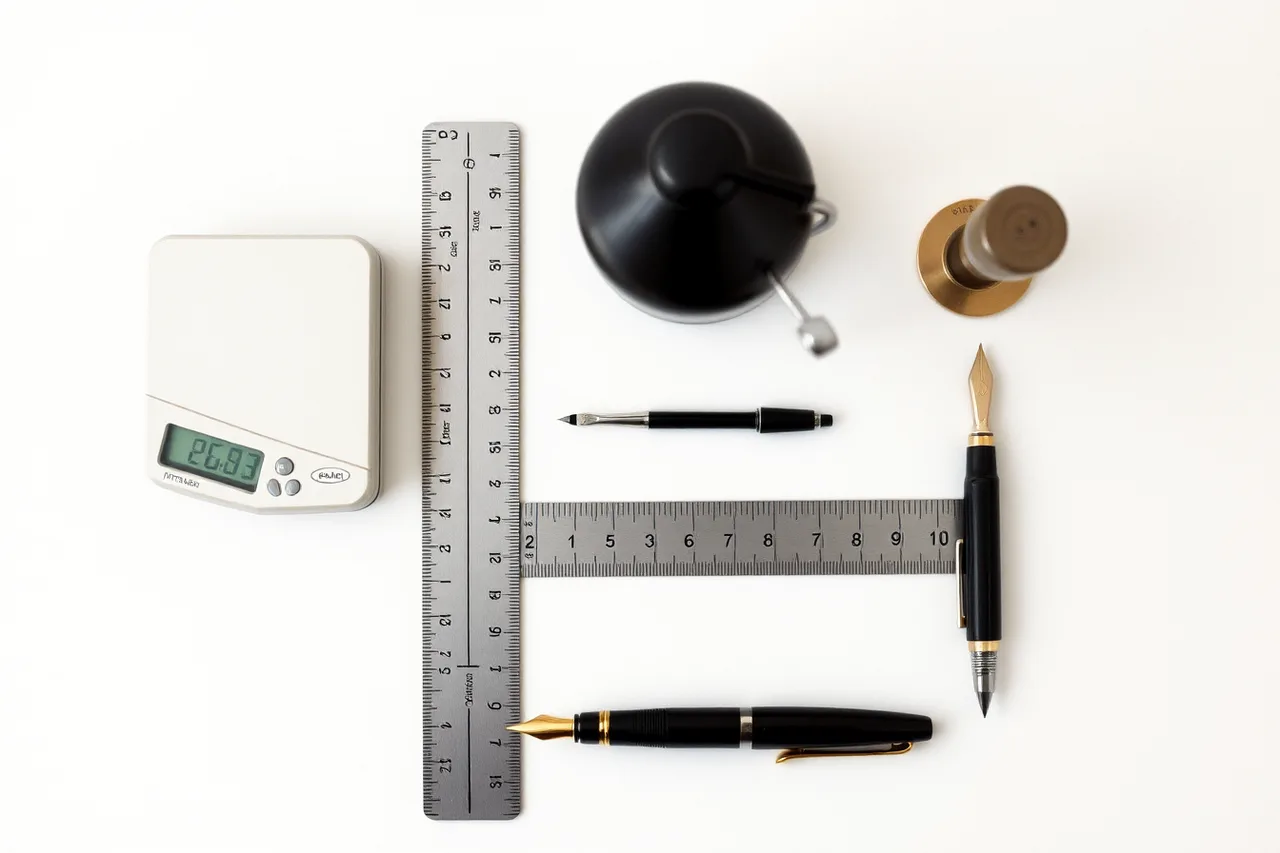
A five-tool starter kit for testing fountain pen paper
Five cheap tools that turn paper opinions into measurements, plus the structured recording habit that makes a year of small tests actually worth something.
You cannot compare paper by remembering it. Two pads tried three months apart will feel the same in memory and behave differently on the desk. The kit below costs less than a mid-range notebook and converts impressions into numbers you can put side by side. The recording habit is the part that matters most and costs nothing.
What to take away
- Five tools cover ita scale, a ruler, a lamp, a loupe and one control pen.
- Record every test the same way, or the results cannot be compared.
- A structured assessment beats a free-form note, which is what institutions discovered too.
- Plot your results if you test more than a handful of papers.
The kit
What it measures
- Kitchen scale to one gram
- Weight per sheet, against the claim
- Steel ruler
- Thickness of ten sheets, sheet size
- Angled lamp
- Formation, watermarks, sheen
- Cheap loupe or phone macro
- How ink sits in the fibers
- One control pen and ink
- Everything else
Substitute
- Kitchen scale to one gram
- None, and it matters
- Steel ruler
- Any accurate rule
- Angled lamp
- A window
- Cheap loupe or phone macro
- Reading glasses
- One control pen and ink
- The pen you already use most
Nothing else is needed. A micrometer is nice and unnecessary, since ten sheets against a ruler gives you a usable average thickness.
Structure the assessment
Free-form notes decay into unusable prose within a month. Institutions ran into the same problem and solved it with structured forms. The Illinois Preservation Self-Assessment Program's user manual describes an application built to lead users through a preservation assessment of paper, bound, photographic and audiovisual material, developed with federal funding and released publicly in 2015.
You do not need software. You need the same fields every time. Use these: date, paper name, stated weight, measured weight, thickness of ten sheets, dry time in seconds, bleed yes or no, feathering none through severe, and one sentence of description.
Plot it once you have ten
Numbers in a list are hard to read. Numbers on a chart are not. The Iowa paper project used a plot library as its primary means of reporting results, with statistical information attached to clarify the strength of the relationship between each pair of variables displayed.
Your version is a sheet of graph paper with dry time on one axis and measured weight on the other. Ten papers in, you will see your own preferences as a cluster, and that cluster is more useful than any recommendation.
What the kit will not tell you
These tools do not measure pH, absolute opacity, or how a sheet will behave in ten years. That is fine.
The kit makes your own comparisons repeatable; it does not reproduce a laboratory.
For a real number, such as pH for paper you intend to keep, buy the paper from someone who publishes it instead of measuring at the kitchen table.
The recording habit
- One notebook for test results, never mixed with writing.
- Same fields, same order, every time.
- Date everything, including the date you bought the paper.
- Keep a taped-in sample of each paper beside its entry.
- Note the pen and ink used, because a result without them is meaningless.
That notebook is the thing you take to a shop, and it is what makes choosing paper fast. What the numbers actually reflect is covered in what paper is made of.