Reviews
Part of How to plan a stationery collection: purpose, inventory, buying order and review
Stationery collections: what to own before the paper arrives
The short list of tools worth owning before the paper, what each one is for, and the vocabulary you need so a paper description means something in a shop.
A stationery collection needs surprisingly few tools. Most of the money that gets wasted goes on storage and on gadgets bought before the collection has a shape. The list below is the whole kit, and it costs less than one good notebook. The second half of this page is vocabulary, which is the part that actually saves money.
What to take away
- The kit is shorta ruler, a folder, a knife, a light, a scale and a notebook.
- Buy tools when a project needs them, not in anticipation of projects.
- Learn six words and paper descriptions stop being noise.
- A kitchen scale and a ruler let you check a weight claim yourself.
The kit
Why
- Steel ruler
- Cutting and measuring sheets
- Bone folder
- Clean folds without cracking
- Craft knife with spare blades
- Trimming, template cutting
- Angled desk lamp
- Seeing formation and sheen
- Kitchen scale to one gram
- Checking paper weight claims
- Reference notebook
- Recording every paper you try
Rough substitute
- Steel ruler
- Any metal edge, never plastic
- Bone folder
- Back of a butter knife
- Craft knife with spare blades
- Scissors, for a while
- Angled desk lamp
- A window
- Kitchen scale to one gram
- None, and it matters
- Reference notebook
- Any bound blank book
That is the list. Cutting mats, guillotines and archival boxes are all reasonable later purchases, and all of them are premature before you know what you actually make.
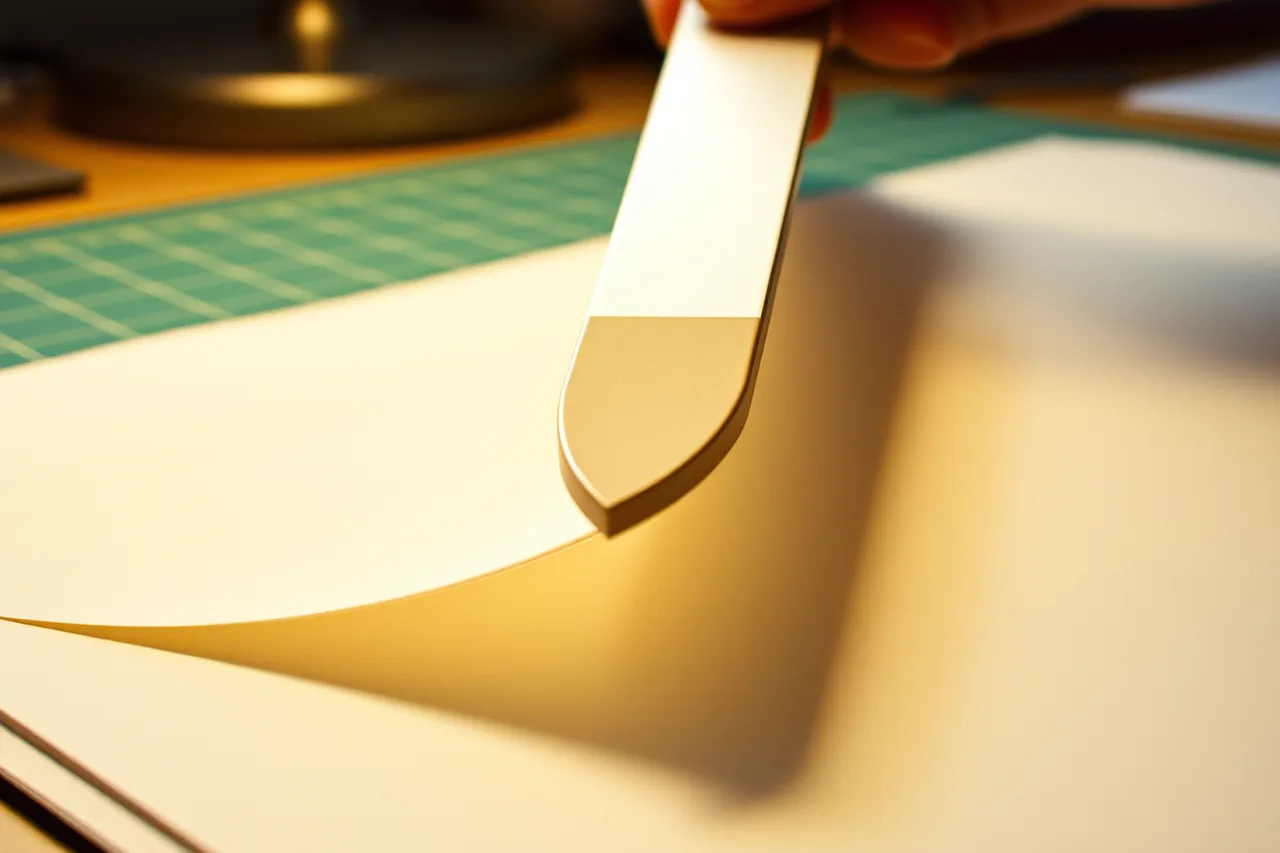
Checking a weight claim yourself
Paper is sold by grams per square meter. To verify, cut a sheet to a known size, weigh it, and scale up. A4 is one sixteenth of a square meter, so multiply its weight in grams by sixteen.
If a pad claims 90 grams and weighs 75, you have learned something about that supplier no review would tell you.
Six words worth learning
- Sizingthe treatment that stops ink soaking into the fibers. Hard sized paper keeps a sharp line and dries slowly.
- Formationhow evenly the fibers are distributed. Check it against a light.
- Grainthe direction the fibers lie. Paper folds cleanly along it.
- Opacityhow much shows through from the other side. Separate from weight.
- Alkaline reservean added alkaline compound, usually calcium carbonate, that neutralizes acid as it appears. The Iowa paper project's glossary defines it as material added during manufacture to counter acidic compounds already in the sheet or arriving later from outside.
- Foxingthe brown spotting that appears on stored paper.
A broader preservation vocabulary is worth having if you keep anything long term. The Illinois preservation glossary covers the condition terms that appear in conservation writing, which is where most reliable information about paper stability lives.
What to buy first with the kit in hand
Once you can measure and record, buy one pad of mid-weight, well sized paper and use a full page. Then buy a second pad that is deliberately different, cheaper or heavier, and compare. Two pads and a record beat ten pads and a memory.
Those results go in planning the collection, and the properties worth comparing are in choosing materials.