Industry
Part of Can pen storage earn its price, or is it just decoration?
Building pen storage by hand, the simple guide small workshops use
Pen storage products makers: what a maker decides before cutting, material, closure, how the pen is held, and why the cheapest construction choices are the ones.
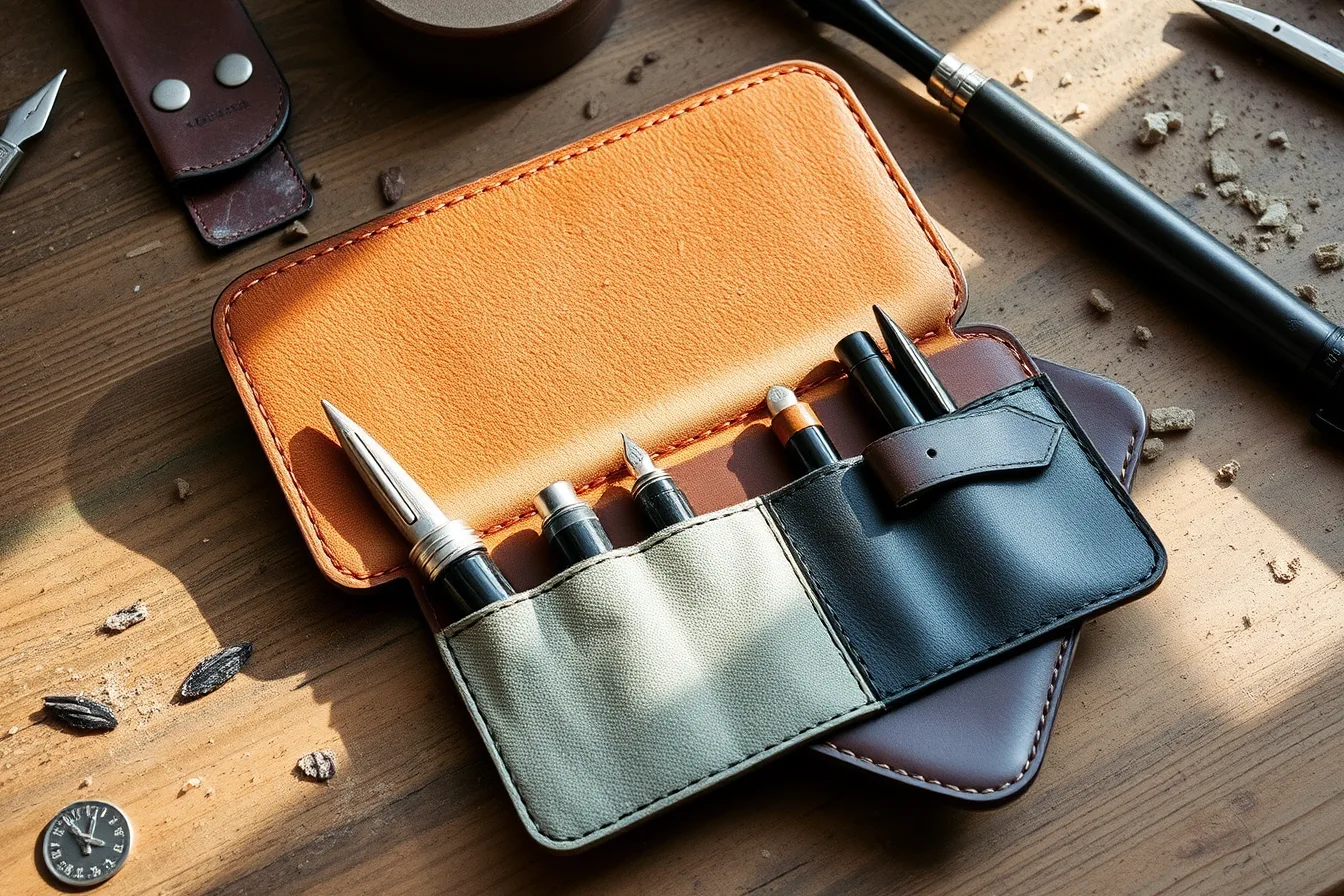
Building pen storage by hand starts with four decisions a small workshop makes before cutting: material, how the pen is held, how the case closes, and whether it can be cleaned.
A pen roll is simple, with few decisions, and all of them are made before anything is cut. Small makers choose all four deliberately. A well made roll from one person often outperforms a mass-produced case.
What to take away
- Four decisions define a casematerial, retention, closure and cleanability.
- Retention is where cheap construction damages pens, usually through tight elastic.
- Natural fibers are the safe default for linings. Foam is not.
- Makers who teach their craft describe their materials, which is a good sign in any seller.
Four decisions before you cut
Options
- Outer material
- Leather, waxed cotton, wool, rigid plastic
- Lining
- Wool felt, cotton, microfiber, foam
- Retention
- Individual sleeves, loose slots, elastic
- Closure
- Wrap and tie, snap, zip
What goes wrong
- Outer material
- Unknown finishes and residual chemistry
- Lining
- Foam crumbles and stains
- Retention
- Elastic marks and cracks caps
- Closure
- Metal closures that touch the pens
Individual sleeves that hold a pen without gripping it are the construction to look for. A pen should slide out under its own weight when the roll is tipped.
Four pen storage decisions
Outer material
- Options
- Leather, waxed cotton, wool, plastic
- What goes wrong
- Unknown finishes, residual chemistry
- Best choice
- Ask tannage and lining
Lining
- Options
- Wool felt, cotton, microfiber, foam
- What goes wrong
- Foam crumbles and stains
- Best choice
- Removable or washable
Retention
- Options
- Sleeves, loose slots, elastic
- What goes wrong
- Elastic marks and cracks caps
- Best choice
- Individual sleeves, no grip
Closure
- Options
- Wrap and tie, snap, zip
- What goes wrong
- Metal closures touch pens
- Best choice
- No metal touching pens
Building a pen roll by hand: seven steps
Small workshops can build this on one table with an OLFA rotary cutter, a self-healing mat and a quilting ruler. A walking-foot machine helps with leather.
Building a pen roll by hand
- Measure the longest pen. Add 1 inch to the slot length and 1/2 inch seam allowance. A 6-pen roll commonly finishes at 10 by 18 inches. A 12-pen roll finishes at about 20 by 18 inches.
- Cut the outer and lining. Use 5 to 6 oz vegetable-tanned leather from Tandy Leather, 10 oz waxed cotton such as Martexin Original Wax, or 1000D Cordura. For lining, use 3 mm wool felt from FilzFelt or 8 oz cotton canvas. Cut both to the same size. Avoid foam.
- Cut the retention strip. Cut a strip 4 inches tall and as wide as the roll, plus seam allowance. Mark vertical lines every 1.25 to 1.5 inches for the sleeves. A 6-pen roll needs five lines if the outer edges form the first and last sleeve.
- Sew the retention strip to the lining. Use a walking-foot machine or hand stitch with John James needles and Gütermann Mara 70 thread. Sew the bottom edge, then sew each vertical line. Backstitch at both ends. Leave the top open.
- Add the closure. Cut a leather lace, webbing strap or twill tape long enough to wrap the rolled case twice. For a snap, set a plastic snap with a Tandy Leather snap setter. Avoid metal zip pulls that can rest on a barrel. A flap over a zip solves that.
- Join outer and lining. Place right sides together. Sew around the perimeter with a 1/2 inch seam allowance. Leave a 3 inch opening. Clip corners, turn right side out, and press. Topstitch the opening closed.
- Test the fit. Slide pens into the sleeves. Tip the roll. Pens should slide out under their own weight. If a sleeve grips, remove the stitches and resew the line 1/8 inch wider. Fill the roll one pen short so pens do not touch in transit.
Leather is not one material
Makers who work in leather know that the tanning process changes what they are handling. A comparative study of leather from different tanning processes characterized how the tanning route alters the resulting material, work aimed at more sustainable practice in the industry.
For a case that is going to hold pens for years, that difference matters. Ask a maker what tannage they use and whether the interior is lined. Unlined leather in direct contact with plated trim is a choice worth understanding rather than assuming.
Makers who teach are easier to evaluate
One reliable signal: a maker can explain their process; museum and workshop teaching pages model this. The Robert C. Williams Museum of Papermaking lists workshop instructors and the techniques each works in: printmaking, book arts, paper weaving, paper sculpture.
A maker who teaches a technique is easier to judge, and so are small-batch stationery formats that publish their methods.
Someone who teaches a technique must describe it. Applied to buying a case, a maker who publishes their materials, their stitch and their lining is easier to trust than one who publishes only photographs, for exactly the same reason.
Cleanability is the decision people skip
Any case in daily use collects ink, dust and skin oils. Most cannot be cleaned at all. A removable lining, or a lining that tolerates a damp cloth, is the difference between a case that lasts a decade and one that becomes unpleasant in two years. Ask about it before ordering, because it cannot be retrofitted.
What to ask a maker before ordering
What to ask a maker
- What is the lining, and is it removable or washable?
- How is the pen retained, and will it mark a lacquer barrel?
- Does any metal hardware contact the pens when the case is closed?
- What tannage or finish is on the outer material?
- Can it be made to hold fewer pens with more space between them?
That last question is the one people forget and the one that most improves a case. What storage has to achieve is set out in judging pen storage, and the equivalent maker questions for paper goods are in how independent makers work.