Industry
Part of How to plan a stationery collection: purpose, inventory, buying order and review
How to judge a paper's quality in a shop before you buy
Where paper quality is decided, how to read formation and the wrapper in a shop, the grain test, and the ink tests to run on one pad before you buy more.
You can judge most of a paper's quality in a shop in a few minutes, before the price tag decides for you. This draws on what papermaking programs and mills have put on record about how sheets are made and what separates a good one from a poor one, rather than on anonymous maker quotes. Most of those distinctions are visible in a shop, if you know what to look at.
What to take away
- Quality in paper is decided at the beating and forming stages, long before the label.
- Formation, the evenness of fiber distribution, is visible by holding a sheet to a light.
- A paper whose wrapper names its mill, fiber and weight can be traced; one that names none of them cannot.
- A sample sheet from a supplier tells you more than any product description.
Where paper quality is actually decided
Fiber preparation comes first. How long the pulp is beaten changes fiber length, drainage and the finished sheet's rattle and strength. Forming comes second, and it is where evenness is won or lost. Pressing and drying come third, and they set the surface.
None of that appears on a package. What does appear, indirectly, is the result. Hold a sheet to a window. An even, cloudlike distribution of fiber is good formation. Visible clumps, wild light patches and floating debris are not, and they will show up later as a line that behaves differently in different places on the page.
Serious claims name their equipment
Apply one test to any statement about paper quality: does the person making it say what they measured and with what? The University of Iowa's paper study published the suppliers and model numbers of every instrument it used, down to the zero-span tester and the positioners built for the spectrometer. That is what makes a finding checkable by somebody else.
Nothing in a shop meets that standard, and it does not need to. But the habit transfers. A paper that states fiber content, weight and mill has given you something to follow. A product that will not say who made it, or what the fiber is, has told you something as well.
How little of this is written down
The Robert C. Williams Museum of Papermaking is building an archive to capture contemporary papermakers, scholars, printmakers and binders in their own words. It has started with a survey to find out who is even working in the field. The archive is not open yet.
That a museum must survey its own trade shows how much of this knowledge lives in individual hands rather than on paper.
How to use this in a shop
- Hold the sheet to a light and look at the formation before you look at the price.
- Flex a corner. Good paper has a sound to it. Limp paper is usually poorly sized or damp.
- Read the wrapper for fiber content, weight in grams per square meter, and the mill. Useful terms are a stated cotton or rag percentage, "acid-free" or "pH neutral", which matter if the pages should last, and any mention of sizing or a coated surface, which predicts how ink will sit. A wrapper with none of these is a guess.
- Find the grain. Bend a sheet gently one way, then the otherit gives more easily along the grain. In a notebook, the grain should run parallel to the spine, or the pages will fight you when the book is open.
- If the shop has a tester pad of the same paper, write on it with your own pen and ink, and turn the sheet over.
- Buy one pad, not five, and put it through the tests in the projects list.
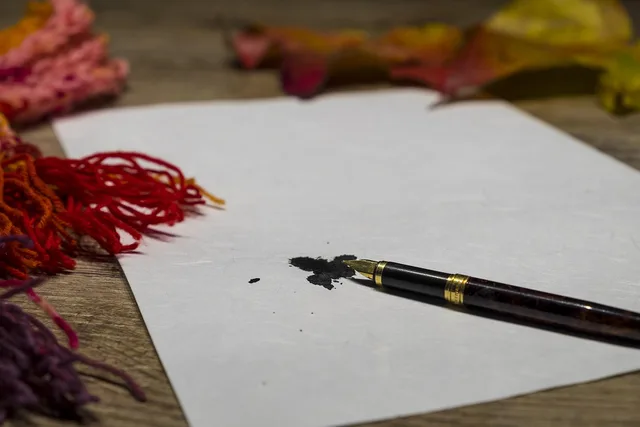
At home, the pad needs five ink tests with the pen and ink you actually use, all on one page:
- Featheringwrite a line of normal handwriting and look at the edges of each stroke under a lamp. Fuzzy, hairy edges mean the ink is spreading along the fibers.
- Bleed-throughmake one slow, heavy stroke and a filled square, then turn the page. Ink on the back is bleed.
- Show-througheven without bleed, check whether the writing is visible enough from the back to disturb writing on that side.
- Dry timedraw a line, wait five seconds, and drag a finger across it. Repeat at ten and twenty seconds until it no longer smears.
- Line qualitycompare a fine stroke with a broad one. On well sized paper both stay crisp; on poorly sized paper the fine line thickens.
Write the result on the cover of the pad with the date, so a later purchase can be compared with it.
What the trade cannot tell you
Makers know how their paper is made. They do not know your pen, your ink, or your hand. They have no incentive to tell you their sheet is wrong for you.
That gap is the buyer's job to close. A personal reference book beats any maker's description. The purpose you set when planning the collection must come from you, not a catalog.