Reviews
Part of How to plan a stationery collection: purpose, inventory, buying order and review
Stationery collections storage: paper and ink in one afternoon
Stationery collections storage: what actually damages paper and ink, which boxes and sleeves are worth it, and a routine you can finish in one afternoon.
Storage is where collections quietly fail. Nothing dramatic happens: a pad kept on an outside wall goes limp and takes ink badly, a box in a warm attic yellows, a bottle stored on its side seeps into the label. All of it is preventable, and almost none of it is prevented by buying a better container. Stationery collections storage comes down to where things sit, not only what they sit in.
What to take away
- Cool, dry and dark beats any container. Location outranks equipment.
- Heat and moisture drive the chemistry that ages paper, so the warm cupboard is the worst cupboard.
- Damp air carries fungal spores. Ventilation matters more than sealing things in.
- Store bottles upright and capped, in a lidded box, below the level of anything you care about.
What actually ages paper
Paper degrades by two chemical routes, hydrolysis of the cellulose chains and oxidation, and both speed up with heat and moisture. A study of paper aging and chemical composition traced how the makeup of the sheet, including its acidity and what was added during manufacture, determines which of those routes dominates and how fast the sheet loses strength.
Heat and moisture speed aging
Cool interior cupboard
- Temperature
- Cool
- Hydrolysis
- Slowed
- Oxidation
- Slowed
- Strength loss
- Slower
Hot loft
- Temperature
- Warm
- Hydrolysis
- Sped up
- Oxidation
- Sped up
- Strength loss
- Faster
For a home collection that reduces to one rule of thumb borrowed from reaction chemistry generally: warmer means faster. A cool interior cupboard is worth more than any archival box sitting in a hot loft.
The damp problem
Sealing paper into an airtight container in a damp room traps the moisture against it. Airborne fungi do the rest.
Ventilate or seal?
Is the room damp or musty?
Ventilate, move paper out
Interior cupboard with gap
A survey of the air mycobiome in a national library recovered twenty-eight genera of filamentous fungi indoors and seventeen outdoors across a year of sampling. That is a reminder that spores are present in the air of any building. They become a problem when moisture lets them grow.
So ventilate rather than seal. An interior cupboard with a gap at the back beats a sealed crate. If a room smells musty, move the paper out of it before you buy anything.
A hygrometer left in the room, and a humidity indicator card inside the box, turn that from guesswork into something you can check at a glance. Where a cupboard does read damp, a sachet of silica gel desiccant holds the moisture down until it needs recharging, and a small dehumidifier in the room does more than any sealed crate.
A storage routine for one afternoon
- Move everything off outside walls, away from radiators, and out of the loft or basement.
- Lay paper flat and closed. Standing pads curl at the edges.
- Slide loose sheets into polyester sleeves before they go into a box.
- Stand ink bottles upright in a shallow lidded box, on a low shelf.
- Keep pens nib up if inked, or empty and dry if they are being stored.
- Label the box with the date you last checked it.
What goes wrong with ink
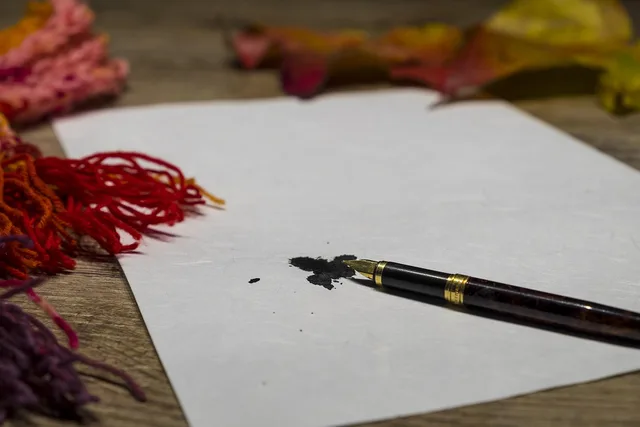
Bottled ink is mostly water, and water evaporates. A bottle opened weekly for two years will be noticeably thicker than a new one. That changes how it behaves in a pen.
Keep bottles closed and out of sunlight. Decant into a small sample vial if you use a color rarely.
Discard any bottle that has grown a film or smells sour. That is contamination, and it will clog a feed.
Temperature swings matter too. A bottle that has been through a cold garage and back can throw a sediment that does not redissolve.
Ink chemistry matters as much as age here. Dye-based inks are the most stable, and a bottle that has only thickened usually comes back with a drop of distilled water. Pigment inks settle, so shake them gently before filling and check the bottom for a hard layer. Iron gall inks are acidic by design: they can corrode a steel nib and keep darkening on the page, so keep them labeled and separate, and think twice before putting them in long-term storage.
Where storage fits the rest of the plan
Storage decisions follow from the purpose set out when you were planning the collection. Daily-use paper can live anywhere convenient. Keeping-grade paper earns the good cupboard. If you are buying containers before you have settled the volumes, hold off until you have worked through the tool kit and know the shapes you own.