Industry
Part of How fountain pen ink reaches the paper: a beginner's guide
How to judge a lettering, calligraphy or book arts class
How to judge a lettering, calligraphy or book arts class before you enroll: the places that teach, what a good first class covers, and what to ask.
There is no ranked list of studios here. Course catalogs change every term, instructors move, and a class that was excellent two years ago may now be a different person teaching a different syllabus. What does not change is the kind of place that teaches this work and the questions that separate a useful class from an expensive afternoon.
What to take away
- Four kinds of places teach thisuniversity book arts centers, museums with working studios, guilds, and library or community programs.
- Guild meetings and library sessions are usually the cheapest way to try a broad nib before buying one.
- Ask what you take home, what is supplied, and how many people share each work station.
- A first class should be about letter shapes and tool handling, not about finishing a project.
The four places worth checking
University centers run the deepest programs. The University of Iowa Center for the Book, for example, teaches calligraphy every semester in classrooms with large table space.
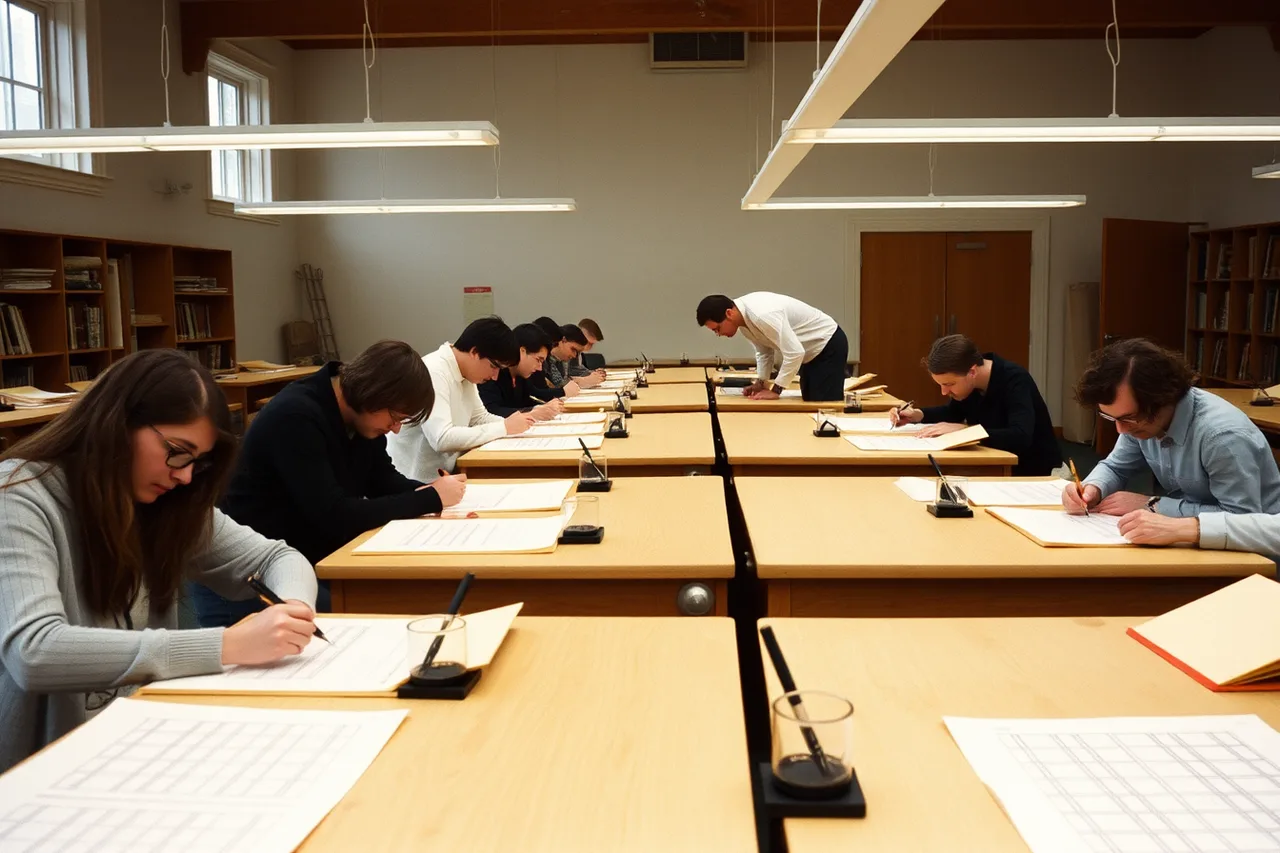
It shares a program with papermaking, printing, and binding facilities. Even if you never enroll, these centers often open short workshops to the public and publish course descriptions, which show what a serious syllabus contains.
Museums with working studios are the second group.
The Robert C. Williams Museum of Papermaking at Georgia Tech runs hands-on sessions tied to its exhibitions, including paper craft workshops covering cutting, folding, scoring and layering. A guided demonstration comes first, then self-directed practice, and that format, demonstration then supervised experiment, suits any beginner class.
Guilds are the third. Most large American cities have a calligraphy or letter arts society with monthly meetings, and the annual dues are usually less than one commercial workshop. The fourth group is your public library and local adult education program, which increasingly run short bookbinding and lettering sessions.
Guilds worth knowing by name: the Society of Scribes in New York, the Washington Calligraphers Guild, and the Friends of Calligraphy in San Francisco. Each posts its workshop calendar online, which is the fastest way to see what a guild class covers before you commit a Saturday to it.
What a good beginner class covers
- Pen angle and how to hold a broad nib without gripping.
- Two or three letterforms taken slowly, rather than a full alphabet rushed.
- Paper and ink behavior, including what happens on the wrong sheet.
- Cleaning and putting the tools away, which is where most drop-in classes fail.
Questions to ask before you pay
Ask whether tools are supplied or expected, and how many students share a table. Is there a demonstration everyone can see?
Ask what you leave with. A sheet of practice strokes beats a finished card in a first class.
Ask whether the class uses dip pens, fountain pens or brush. Those are three different skills, and a good first class teaches one of them rather than rotating through all three.
If a course description will not answer those, that is your answer. Compare it against the same criteria you would apply to any first purchase decision, which is to define the outcome before comparing the options.
What you cannot learn in a room
Classes are good at posture, tool handling and the shape of letters. They are poor at the slow part, the daily quarter hour that turns a demonstrated stroke into your own hand. Nobody can supervise that for you.
A class is worth its price when it removes a bad habit early, and the habits worth removing are almost all grip and speed. Read the field guide before you sign up so that you arrive already knowing what a nib and a feed do.