Guides
Part of Real paper collection surveys teach lessons private collectors miss
Free lessons on paper and ink: a beginner project
Recorded museum lectures, an open university study and public databases give you free paper and ink lessons — plus a beginner project you can run at home.
The best material on paper and ink is free, published and almost entirely unread by the people who would benefit most. Museums record their lectures. University projects publish their data. Researchers state plainly what they still do not know. None of it requires a subscription and very little of it requires a background in chemistry. Any of it can become a beginner project you run at the kitchen table.
What to take away
- Recorded museum lectures are the easiest entry and cost nothing.
- Published project sites often include the raw plots, not just the conclusions.
- Read the future work section first. It tells you what is genuinely uncertain.
- Take one open question and test it yourself, at kitchen-table scale.
Where the free material is
| Source | What you get | Effort |
|---|
Free material sources
Source
- Museum lecture recordings
- Artist and technical talks
- University project websites
- Methods, data, plots
- Open-access journals
- Full studies with methods
- Library special collections guides
- What exists, how to see
- Workshop handouts and syllabi
- Structured teaching sequences
What you get
- Museum lecture recordings
- Low
- University project websites
- Medium
- Open-access journals
- Medium
- Library special collections guides
- Low
- Workshop handouts and syllabi
- Low
Effort
- Museum lecture recordings
- University project websites
- Open-access journals
- Library special collections guides
- Workshop handouts and syllabi
Here is that table filled in, source by source.
- Robert C. Williams Museum of Papermaking lecture recordingswhat you get: free recorded talks on sheet forming, bookbinding, surface design and exhibit work, sorted by category and type. Effort: one sitting, and nothing to read first.
- University of Iowa paper studywhat you get: a public project with its methods, its results and a future work page that names what is still unknown about gelatin and paper stability. Effort: an evening of reading.
- Public research databaseswhat you get: open-access papers and scanned books on sizing, cellulose degradation and iron gall corrosion, indexed by services such as Google Scholar and the Internet Archive. Effort: slow, and free.
- Getty Conservation Institute publicationswhat you get: conservation research on paper and books, published free to read. Effort: the deepest reading here, best saved for a specific question.
Start with recorded talks
Museums have quietly built substantial video archives. The Robert C. Williams Museum of Papermaking publishes lecture recordings sorted by category and type, covering demonstrations, artist talks, bookbinding, sculpture, surface design and exhibit talks.
Watch two before you read anything. A demonstration of sheet forming makes every later description of formation, drainage and pressing legible in a way that text does not.
Read the open questions, not just the answers
The most useful page in any research project is usually the one nobody links to. The University of Iowa paper study's future work section states that ways gelatin contributes to paper stability merit further research.
It asks whether gelatin's film-forming properties limit penetration of pollutant gases. It suggests air pollution may be a main contributor to paper stability loss over time.
That is a live question, written down by people who spent years on the subject. It also tells you something practical immediately: if pollutant gases matter, then where you keep paper matters as much as what the paper is.
Read the methods when you need them
The methods section is where most people stop. It is also where the useful detail lives once you have a specific question.
A study that ages paper under controlled temperature and humidity in a lab is showing you what accelerated aging means. A month in your window is not the same claim.
Turning reading into practice
- Pick one open question that you could observe at home.
- Design the smallest test that would tell you anything.
- Run it with a control, and record the conditions.
- Write down what happened, including that it may mean nothing.
- Repeat it in a different season.
You will not settle a research question this way. That is not the point. Reading becomes retention once you have tried something.
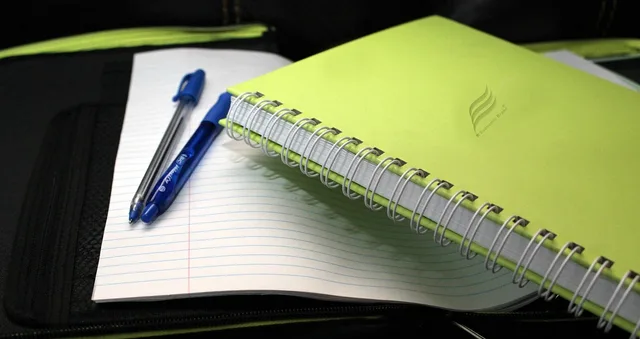
The questions closest to this publication are the cheapest to start with. Does the same ink feather differently in two notebooks with different sizing? Why does a line from an iron gall ink darken over the years and eventually corrode the paper, while most modern inks sit on the surface? Iron gall corrosion is one of the best-documented problems in paper conservation, and iron gall inks are still sold for fountain pens. Both questions have real literature behind them, and both can be watched from a desk.
The record-keeping that makes such tests worth running is in a practical setup for stationery records. Seeing the material made in person, when a museum or a mill near you opens its doors, is worth the trip.