Reviews
Part of How to test whether a notebook suits your fountain pen ink
Notebook and ink pairings buying: one starter set
Notebook and ink pairings buying starts with a Rhodia Webnotebook A5, Waterman Serenity Blue, and a Rhodia No. 16 pad for a repeatable control.
This notebook and ink pairings buying plan starts with a repeatable baseline, not an ink sampler. Buy an ink sampler only after you have a paper you trust; otherwise, changing paper and ink at once makes the results hard to interpret. Start with one notebook, one bottled ink, and one loose pad, then keep the pen and writing sample consistent.
What to take away
- Buy one notebook, one bottled ink, and one loose pad, in that order. Nothing else.
- The loose pad is the control. It never changes, so every later comparison means something.
- Skip recycled and very cheap paper at the start, since it introduces variables you cannot see.
- Spend the saved money on a second notebook only after the first is half full.
The three things
What to look for
- One notebook
- Around ninety grams, sewn or lay-flat binding
- One bottled ink
- A plain dye ink, blue or black, from any established maker
- One loose pad
- The same paper you already know behaves
Why first
- One notebook
- It is what you actually write in
- One bottled ink
- Colors and behaviors both settle later
- One loose pad
- It is your control for every future test
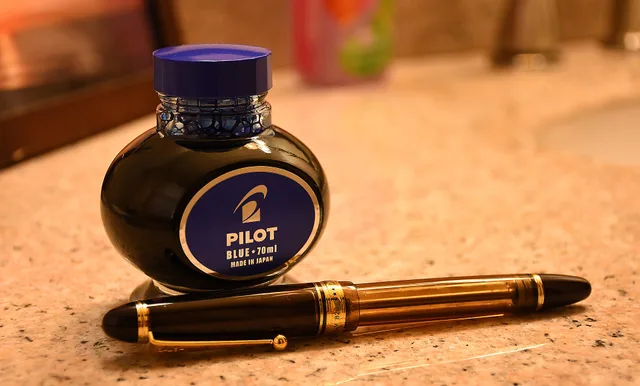
For a concrete starter set, choose a Rhodia Webnotebook A5, Waterman Serenity Blue bottled ink, and a Rhodia No. 16 notepad. Use the ink in the notebook, then write the same sentence with the same pen and ink on the pad as your repeatable control. This is a starting combination to test with your pen, not a guarantee that every nib will behave identically.
The three first buys
- One notebookaround ninety grams, lay-flat binding
- One bottled inkplain dye, blue or black
- One loose padpaper you already know
- Not a sampler, not a second pen
Two details are worth insisting on. The binding should let the book lie flat. A book you must hold open makes you write across a slope and blame the paper.
The loose pad should be a paper you can buy again next year. A control sheet you cannot replace stops being a control the day it runs out.
Why recycled paper is a bad first choice
Not because it is worse, but because it varies more. Recycling changes the fibers themselves. Research on the wettability of pulp fibers during recycling has tracked how repeated processing alters how fibers take up water and how that relates to the tensile strength of the resulting paper. Shorter, differently wetting fibers mean more absorbency and more variation between batches.
Recycled vs predictable paper
Recycled paper
- Fiber
- Shorter, altered
- Water uptake
- Changes each cycle
- Absorbency
- Higher
- Batch variation
- More
- Use it
- Later
Predictable paper
- Fiber
- Consistent
- Water uptake
- Stable
- Absorbency
- Known
- Batch variation
- Less
- Use it
- First
Start with something predictable. Come back to recycled stock once you can tell the difference between a paper problem and an ink problem.
Why one control sheet is worth more than five notebooks
A fixed reference point only proves its worth once you have one. Historical paper analysis works the same way: compare everything against known measurements.
The University of Iowa's project overview argues that close study of the paper itself reveals what documents alone cannot, including inferences about a writer's circumstances from the quality of the sheet.
You are doing a small version of that every time you write the same sentence on a new pad next to your control sheet. Without the control, you have impressions. With it, you have a comparison.
The order to spend in afterward
- Second ink, once the first bottle is a third gone.
- Second paper, chosen to be deliberately different from the control.
- A converter, if your pen came with cartridges.
- Storage, last, once you know what you own.
Do not buy a sampler pack until you have written a full notebook. By then you will know whether you want drier or wetter, and the sampler becomes useful rather than confusing. For broader comparison methods, see the pairing guide; the habits behind them come from how makers work.