Reviews
Part of 5 things nobody tells you about ink testing methods
What to buy first for testing ink at home: a closer look
A short list of testing equipment that earns its place, what a flatbed scanner adds, and the line beyond which home testing stops being possible.
Almost everything needed to test ink is already in the house. The purchases that genuinely help are few, specific and unglamorous, and they are not the ones people buy first. What follows is the order to acquire them in, what to put in the cart at each step, and an honest statement of where home testing stops.
What to take away
- Buy a control paper before any equipment at all: Rhodia or Clairefontaine at the smooth, coated end, HP Premium 32 lb laser paper at the absorbent end.
- A flatbed scanner at fixed settings is the single most useful device you can own.
- A timer and a 10x loupe cover most of what is left.
- Composition analysis is not available at home at any reasonable price.
The buying order
| Order | Item | What it makes possible |
|---|---|---|
| 1 | A control pad of known paper | Any comparison at all |
| 2 | A second control paper, deliberately different | Bracketing a result |
| 3 | Distilled water | Rinsing and dilution without minerals |
| 4 | A flatbed scanner or a fixed phone rig | Repeatable capture |
| 5 | A gray card | Color you can correct against |
| 6 | A loupe or a phone macro lens | Seeing ink in the fibers |
| 7 | A timer | Dry times you can compare |
None of the first three is a specialist purchase: a stationery shop, an office-supply store or an online pen retailer will have them. Weigh them against what you already spend on ink and refills, not against laboratory equipment. If only one purchase is affordable right now, make it the paper.
Ink Testing Buying Order
- 1. Control pad of known paper
- 2. Second control paper, deliberately different
- 3. Distilled water
- 4. Flatbed scanner or fixed phone rig
- 5. Gray card
- 6. Loupe or phone macro lens
- 7. Timer
What to put in the cart
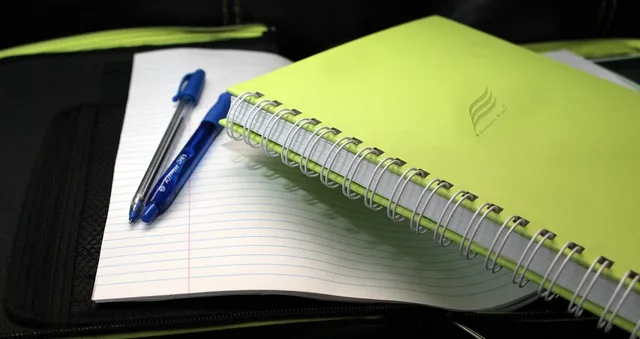
Paper first. Buy a Rhodia pad (No. 18, dot grid) or a Clairefontaine pad; both are smooth and coated, and they behave the same from sheet to sheet. A ream of HP Premium 32 lb laser paper is a more absorbent alternative and gives you hundreds of identical sheets, which is what a control really means.
Second, a contrasting paper. Pick something that behaves differently rather than more of the same: Tomoe River 52 gsm is thin, coated and slow-drying, and reading it against office paper will tell you more about an ink than two similar pads would.
Third, the scanner. A basic letter-size flatbed such as the Canon CanoScan LiDE 300 or the Epson Perfection V39 is enough. Set it to 600 ppi, turn automatic correction off, write the settings down and never change them.
Then the small items. A kitchen timer for the ten-second rinse and the one-day drying time, a 10x jeweler's loupe or a clip-on phone macro lens, a photographic gray card, and a bottle of distilled water for dilution and the final rinse. All of them come from a stationery shop, an office-supply store, a camera shop or a supermarket.
What the scanner buys you
Fixed-geometry capture turns your notes into data.
Forensic work leans on that idea: one preliminary investigation set out a two-step, non-invasive process to determine chronological deposition order of fingerprints and printed ink on paper. That order depends entirely on capturing the same surface the same way twice.
The requirement is consistency, not resolution. Set the scanner once, with automatic correction turned off, write down the settings, and never change them. A cheap scanner used consistently beats an expensive one used casually.
Where home testing stops
It is worth knowing the boundary so you do not waste money chasing it. Determining what an ink is actually made of takes instruments. One study distinguished gel pen ink stains using desorption electrospray ionization mass spectrometry combined with clustering, in the context of detecting alterations to handwritten documents.
Nothing on a domestic budget approaches that. You cannot determine dye against pigment, you cannot date an ink, and you cannot identify a formulation. Accept the boundary and spend the money on paper instead.
Spend the difference on paper
Money not spent on instruments has an obvious home. Buy two or three well chosen papers as full pads, not samples. In a month they will teach you more about your inks than any device.
Paper changes results most. It is the one variable you can control, and the one you will use up either way.
What not to buy
- Ink samplers, before you have a control paper and a routine.
- A colorimeter or spectrophotometerthe sort of calibration instrument sold as an X-Rite i1 — unless you already know why you want one.
- A microscope; a 10x loupe is enough to see ink sitting in the fibers.
- Specialized testing paper, since your own everyday paper is the relevant test.
The equivalent list for paper testing tools is in our beginner tool kit for fountain pen paper, and the procedure that all of this equipment serves is in what happens during a typical ink testing project.