Maintenance
Do these eight fountain pen faults have real fixes?
The eight faults that account for nearly every fountain pen complaint, what causes each one, and the fixes to try, in the order you should try them.
Almost every fountain pen complaint reduces to a short list of faults, and most of them are not faults in the pen. They are evaporation, pressure, the wrong ink for the paper, or a cleaning routine that never happened. The order below is the order to work through, cheapest and most likely first.
What to take away
- Try the free fixes first: flush it, cap it, change the paper, press less.
- Evaporation causes hard starts. It is the single most common complaint.
- Pressure is a habit carried over from ballpoints and it makes writing worse, not better.
- Take a pen apart only after the simple checks, and only as far as it is designed to come apart.
The eight faults, in order
| Symptom | Most likely cause | First fix |
|---|---|---|
| Hard start after a pause | Ink dried at the tip | Cap between sentences, flush the pen |
| Skipping mid-word | Nib rotated off its sweet spot | Turn the pen slightly, watch the line |
| Line too wide, feathering | Paper, not pen | Test on the control paper |
| Blobbing on the page | Heat, or ink past the feed buffer | Let it settle, wipe the nib |
| Scratchy in one direction | Tines misaligned | Look at it under a loupe before touching it |
| No flow at all | Dried ink in the feed | Soak the section in cool water |
| Ink in the cap | Stored nib down, or temperature change | Store nib up |
| Writing looks worse than before | Grip pressure | Write lighter until the ink almost fails |
Why pens dry out
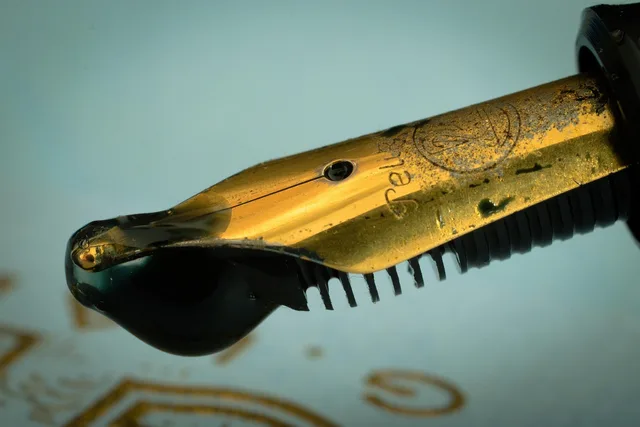
The mechanism is unglamorous. Water leaves the exposed ink at the tip, the remaining pigment or dye concentrates, and what is left will not flow. That is evaporation, the same process that moves water out of any exposed surface, running faster when the air is warm, dry or moving.
How Ink Dries at the Tip
- Exposed ink at tip
- Water evaporates
- Pigment or dye concentrates
- Ink will not flow
- Cool water and time reverse it
Every practical rule follows from that. Cap the pen when you stop. Do not leave it uncapped on a warm desk. Do not store a filled pen for months. If it has already happened, cool water and time will usually reverse it, because nothing has been damaged.
Pressure is the fixable habit
The complaint that writing looks worse with a fountain pen is real and has a mechanical cause: handwriting quality can be tracked through the movement itself.
Work analyzing handwriting legibility through hand kinematics measured the relationship between how the hand moves and how legible the result is. That is the formal version of what you notice when you slow down.
A fountain pen needs almost no downforce. Writing lighter feels wrong for about two pages and then feels obvious. If your pages emboss on the reverse, that is the fault, not the nib.
What not to do
Avoid hot water, which loosens adhesives and warps plastics. Do not use dish soap in a converter unless you intend to spend an hour rinsing it out.
Do not pull a nib and feed out of a pen you have not seen taken apart before, and do not bend tines back with a fingernail.
Most damage in this hobby comes from a confident second intervention after the first one did not work.
The underlying mechanics are in the field guide, and the paper side of these complaints is in notebook and ink mistakes.
Common questions
How often should I flush a pen?
My pen writes fine then stops after a page. Why?
Is a scratchy nib always misaligned?
Should I ever use vinegar or ammonia to clean a pen?
In this guide
- A small-desk setup guide for avoiding common pen mistakesDesk setup that prevents the usual pen problems: most pen faults come down to where things sit. How to arrange a small desk so that capping, storage.
- Fountain pen mistakes: companies, guilds and showsThe fountain pen mistakes companies and guilds can help with: pen shows with nib specialists on site, maker service centers, and how to describe a fault.
- Photographing a fountain pen fault so someone can helpWhat a useful nib photograph looks like, the three shots that answer most questions, and the capture notes that turn a picture into evidence.
- Top fountain pen maintenance tools for 2027, reviewedA reviewed short list of the fountain pen maintenance tools worth owning in 2027, and why the two most popular buys are the likeliest to ruin a nib.
- 5 things to weigh up on fountain pen mistakesFive fountain pen mistakes that cause most faults: wrong paper, too much pressure, skipped flushing, bad storage, and guessing before testing.